
DEATHBED CONFIDANTE
Dr Kanchana Coore’s quiet work at the edge of life
Published:Sunday | February 1, 2026 | 12:11 AMErica Virtue - Senior Gleaner Writer
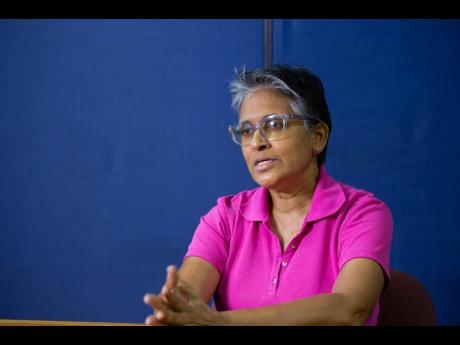

By the time patients reach the final stretch of their lives, the questions they bring to Dr Kanchana Bandara Coore are rarely medical alone. They are about children who will be left behind, marriages that still need tending, estranged relatives who must be seen one last time, and how – exactly – they want to leave this world.
For more than 30 years, the Sri Lankan-born Jamaican general practitioner has borne witness to these conversations, offered in hushed voices at bedsides and in quiet rooms, often after families have gone home. They are moments of extraordinary trust, she says, and ones for which no medical textbook ever prepared her.
“Nothing in my training prepared me for some of the things people say when they are transitioning,” Coore reflected in an interview with The Sunday Gleaner. “And nothing prepares you for how to cope when they pass.”
A graduate of The University of the West Indies, Mona, Coore served at both Mandeville Regional Hospital and Kingston Public Hospital (KPH) before moving into private medical care. Along the way, she developed a deep commitment to palliative care – an approach that, she explains, shifts medicine away from treating diseases alone and back toward caring for people.
“It looks at the patients we care for as people,” she said, “rather than people that we care for with diseases that we treat.”
BEYOND THE DIAGNOSIS
Palliative care is most often offered to individuals in the advanced stages of illness – late-stage cancer, kidney disease, and other life-limiting conditions. But for Coore, it is not merely about managing pain or symptoms. It is about relationship.
She has known many of her patients for years. Time spent with them – and with their families – breaks down formality and fear, opening the door to what she calls “end-stage discourse”: honest conversations about dying that are rarely taught or practised in conventional medicine.
From that vantage point, she has become, quite literally, a witness to life and death.
“I can’t say I’ve met a single patient,” she noted, “that I’ve said to them, ‘If you could decide where you draw your last breath, where would you want that to be?’ who said they wanted to die in the hospital.”
Instead, patients talk about avoiding unnecessary expense for their families, about dying in their own beds, in their own homes, surrounded by familiarity rather than machines. Others wrestle with decisions about aggressive treatments.
“Not, ‘If I’m going to die’,” she said, “‘but I know I’m going to die. I don’t want to die on my back. I want to die with my boots on.’ Meaning, I want to do all that is important to me for as long as possible.”
Some wishes are simple but profound: peace, comfort, and the presence of one particular person before the end.
“I’ve had patients where we recognise they are at end of life, and I will say to the family, ‘Whoever needs to come, you tell them to come now,’” she explained. “Because we don’t know how much time they have.”
WAITING TO LET GO
Over the years, Coore has observed patterns that still move her. Patients who seem to hold on until a long-absent relative arrives. Others who linger until a final conversation is complete.
“I’ve had patients who wait for the relative from abroad to come,” she said. “And within hours of that person arriving, they’re gone. They open their eyes, see the person at the bedside, hold their hand. Whatever needs to be said is said – and then they go in peace.”
Perhaps most striking, she added, are those who need permission to die.
“They want to know that their loved ones are going to be okay,” she explained. “You tell them you’re going to miss them, that you’ll be sad and cry – but that you will be fine, and they can go on.”
When families are guided to have that conversation, she has seen the struggle melt away.
“They relax,” she said softly. “And they go.”
Others express clear preferences for their final days: no pain, no feeding tubes, no prolonged suffering. These wishes, she insists, deserve to be heard and respected.
A DIFFERENT KIND OF MEDICINE
At its core, palliative care is about presence.
“It emphasises the relational aspect of practice,” Coore explained, “rather than it being transactional – where you come in, get a diagnosis, get a prescription, and leave.”
Human health, she said, is not only physical. It is emotional, mental, spiritual, and deeply social.
Among the terminally elderly – many of whom have lived well beyond the biblical three scores and 10 – there is often a sense of readiness. For them, additional years feel like a blessing, and the focus becomes comfort and meaning rather than cure. In other cases, unresolved relationships weigh heavily, making it difficult for patients to let go.
Yet despite its value, Coore believes the current health system does not adequately support palliative care across the sector. Many doctors, she said, are reluctant to raise the issue at all.
In her own practice, she begins by asking patients what they understand about their illness.
“There are a lot of technical terms that come in – half of which they don’t understand,” she said. “But I never hear, ‘This is the end.’”
When patients say, “The doctor said there’s nothing we can do,” she reframes the conversation.
“I remind them that as a human being, you are not just a body,” she explained. “You also have a spirit, and your body is really a container for the spirit.”
That container, she tells them gently, has an expiry date. When it can no longer serve its purpose, the goal shifts – not to prolong suffering, but to allow the spirit to leave in peace.
“And the amazing thing,” she said, “is that once I raise it – once I put it that way – I’ve never had anybody become frightened. It’s almost like I’ve given them permission to talk about dying.”
LESSONS FOR THE LIVING
Coore offers a clear message to healthcare providers: delaying death at all costs is not the goal.
“Your responsibility is not to eternally delay death,” she said. “Your responsibility is to be present with the patient for the journey – for the entirety of the journey, if at all possible.”
It is a philosophy shaped by contrast. Early in her career at public hospitals, she was a young doctor pronouncing deaths caused by gun violence, knife crimes, and carelessness – lives cut short, futures unrealised.
“Those transitions,” she reflected, “could not be peaceful.”
She added: “When I was in the public system, I don’t think I ever saw any peaceful deaths in the hospital. They were all traumatic. And I was traumatised. I sat down and bawled. And my colleagues would tell me, ‘You can’t get so involved with the patients. You can’t be bawling and all of this over the patient.’”
Despite her short stint at KPH, it still left her traumatised, perhaps more so than at Mandeville.
“The deaths that I saw at KPH were all traumatic – gunshots and stab wound and things that come in. When I went home, I bawled, yeah. ... For those, it’s not so much the death. I think for me, it was more a bawling because it just felt like life meant so little,” she told The Sunday Gleaner. “You see the police come up with four, five, six young men thrown down in the back of a pickup. They’re all dead, and they’re just thrown down in there like sack. And one of the doctors has to go out there and pronounce all of them. That was upsetting to me.
“You’d see a young, healthy-looking male come in. He’s coming in for a gunshot wound. And when you look on his chest, you see how much surgeries he’s had and how much stab and what-not. It went from the type of scars that you see and you can tell which ones are surgical and which ones were injuries,” she explained.
“And chances are, the surgery was for the injuries. You have to ask yourself why these young men put themselves out there to get this happening over and over again. And then one day, one of those men would come in and they die, regardless of what you’re trying to do. You die,” she said.
Facing such deaths left her angry, disappointed, feeling like a failure, Coore said, recalling a case of one young man who died while they tried to find a vein to insert a drip after he was rushed in losing a lot of blood.
“I don’t remember us having any sort of a session, a debrief session afterwards, for people to just feel sad about the fact that we’re losing people who didn’t need to die,” she recounted.
Another, an asthmatic, died after seeking medical care too late after an attack.
She recalled that she was “distraught”.
Perhaps it was these “feelings” that took her on the course palliative care.
PERSONAL ROAD
At the very beginning of her medical career, Coore’s father shared with her a quote by Sir William Osler that would quietly guide her practice: “The practice of medicine is an art, not a trade; a calling, not a business.” Years later, in the full circle of life, she would draw on those words again – this time as a daughter, not just a doctor.
In a blog post titled ‘Pillows for My Father’, her account of her father’s illness and death, she chronicles his diagnosis of stage four lung cancer in 2005 and the seven difficult months that followed. From the outset, signs pointed to a terminal illness – fluid compromising his breathing, relentless pain, and, eventually, scans revealing cancer in his spine and at the base of his skull.
What troubled her most, she wrote, was not the diagnosis, but how it was handled.
“At that time,” she recalled, “doctors who treated my father displayed about as much finesse as an elephant on a rampage in breaking bad news.”
There was little space to absorb the reality of his condition before aggressive chemotherapy and radiation were proposed. No honest conversation about prognosis. No discussion that, regardless of the path chosen, death was inevitable. Statistics about the limited benefit of treatment in advanced cancer were avoided, as was any acknowledgement of “the incredible emotional toll hearing such news takes on the patient and his family”.
There were no family meetings. No mental health support. No one asked her father what mattered most to him, or how he wanted to spend the time he had left.
Good palliative care, she reflected, could have bridged that gap – offering an option between relentless intervention and abandonment. At the time, she was already a doctor herself, yet still found her family fumbling through conversations no one had helped them have.
She, her mother, and her sister watched as her father endured “incredible” pain, smiling through morphine that stiffened his mouth and dulled his speech. Eventually, they learned what he wanted: to die at home, and to be cremated. As his condition worsened, well-meaning relatives questioned why he was not in hospital. The answer was simple – home was where he wanted to be.
In those last days, she recalls buying him a pair of soft pillows, just to do something. The feel of them brought him quiet joy, which he shared with his wife. He died resting on those pillows.
That experience crystallised a truth she now shares with both families and fellow physicians: death is not a medical failure.
“Doctors must accept that all will die, including them,” she has said. “It is the one guarantee of life. We cannot change the outcome, but we can change the path we take to reach that outcome.”
Today, that lesson lives at the heart of her work.